

Menorca is the Perfect EuroSummer™ Destination
Issue 018: The Balearics' calm, quiet "middle sister" is slowly coming out of her shell. Now's an ideal time to pay her a visit.

This issue of Far-Flung Corners is published with special thanks to Comme Si.
Zara Larsson puts it perfectly: it (finally) feels like EuroSummer™! Time for lotion-fragranced, sun-kissed skin. Scorching days that slip into balmy nights. Billowing linen worn over tight swimsuits. Sea salt in the hair and sand between the toes. Tinto de verano in the plazas and cervezas on the playas. You get the idea.
And you hopefully realize why, instead of celebrating July 4 and America’s 250th birthday in the States, we decided to spend this year’s Independence Day, erm, independently. Spain was a much more enticing option, so a large group of us convened in Madrid for four days of partying, bar crawls, drag performances, and the like during Pride. The Spanish capital, it turns out, is the real city that never sleeps.
After all that excitement and energy, we needed somewhere to decompress. Though I haven’t visited since I was a kid, I’d heard plenty of recent murmurs about Menorca being the perfect low-key, largely American-free escape. Plus, it’s a cheap, 90-minute Ryanair flight from Madrid. So we chose the Mediterranean island as our comedown destination for a few days.
Of the three main Balearic Islands, Mallorca is the grown-up, bougie, dramatically fabulous sister. Ibiza—as I’ve discussed before—is the young, carefree, hippie party animal. And Menorca? Until recently, the “middle sister” has remained quiet, demure, and family-oriented. But she’s finally showing more personality—or rather, she’s slowly being discovered by travelers outside the UK, Spain, and France.
Menorca’s relative obscurity is a huge blessing. Even in early July, when most of the Med is heaving, the island feels sleepy and laid-back. Much of its arid yet fertile landscape has remained untouched for centuries, development has been confined to a handful of small resorts, and the overall vibe feels far less showy and more authentic than that of its neighbors. Effortless, natural, and enticing.


Though Menorca is compact, and fairly flat compared to its sisters, the terrain makes it surprisingly tricky to get around. Countless steep ravines radiate from the center of the island to the sea, preventing the construction of a coastal ring road that would allow drivers to hop easily from one gorgeous beach or charming town to another. Instead, most roads connect to the main highway that runs from Maó—the capital, port, and airport hub in the southeast—to Ciutadella, the historic former capital in the northwest. It’s only about an hour’s drive from end to end, but most journeys on the few main roads elsewhere take much longer than you’d expect from glancing at a map.
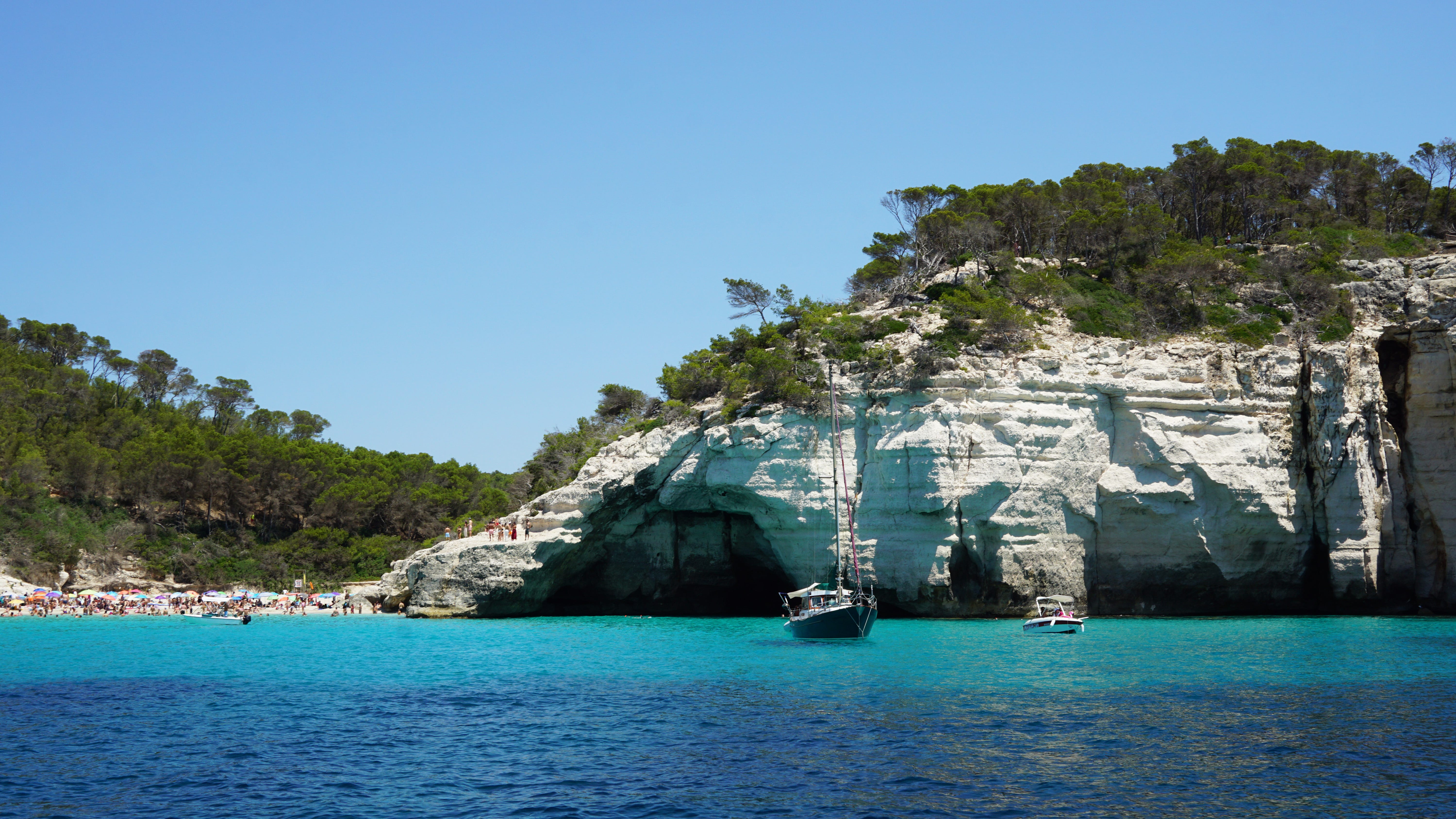
It’s this topography that has produced Menorca’s famous calas—long, narrow coves framed by steep limestone cliffs and filled with shallow, crystal-clear water in the brightest shade of turquoise I have ever seen (and I’ve witnessed a lot of Miami apartment décor). Many of these secluded, sand-tipped spots can only be reached via a long hike, a popular past time for visitors here, and because driving between them isn’t especially convenient either, beach-hopping—our favorite EuroSummer™ activity—becomes surprisingly difficult.
So if you’re hoping to visit several of these aquamarine gems, particularly along the spectacular south coast, the best option is by boat. We booked a three-and-a-half-hour private cruise on a small, traditional Menorcan former fishing vessel one afternoon and set sail from Cala Galdana—which was the only overcrowded place we encountered, and frankly a nightmare for parking. Be warned!


Blasting a playlist we’d compiled of nostalgic late-2000s dance tracks (plus some Zara Larsson, obvi), we sailed past the chalky cliff faces, cruising from cala to cala. Noting their subtle differences, the aim was to find the most beautiful and secluded spots in which to stop and swim. We paused briefly for a dip at Cala Fustam before continuing west, bopping into several more bays, including Cala en Turqueta—named, our captain explained, after the Ottoman invasion of the island in 1558.
We eventually dropped anchor at Cala des Talaier, which was uncrowded and where the water looked unreal. But there was one little problem: jellyfish. We spotted one of the cheeky f*ckers as soon as we dived in, but while swimming toward shore, more appeared in front of our goggles and several people in our group got stung. Ouch. Nothing too serious, but enough to send us all scrambling back onto the boat fairly swiftly.
The jellies made themselves a nuisance again later that day while we were cliff jumping at Cala en Brut, a small cove our friends staying nearby had stumbled across. The inlet is surrounded by stepped concrete platforms used by local families as sunbathing terraces and launchpads for plunging several meters into the deep water. Between the natural beauty enhanced by the slowly setting sun, the squeals and laughter from jumpers and spectators, and the irony that the jellyfish had followed us there, this became one of the trip’s most memorable moments.


Back on dry land, the best luxury hotels across Menorca are hidden gems, too. Among the standouts are the twin Son Ermità and Binidufà estates in the north, a colorful location from the Experimental Group, and Torralbenc, a member of the Small Luxury Hotels of the World collective where we enjoyed our final dinner.
We spent our three nights at Santa Ponsa, part of the Fontenille Collection that also operates the property we stayed at in Provence, and another hotel I visited in Tuscany earlier this year. Santa Ponsa, a 17th-century finca in Menorca’s south, sits above a secluded valley of terraced gardens blooming with flowers planted between low stone walls and pathways surrounding a towering central palm. The silence was broken only by birdsong and the gentle trickle of water through irrigation channels. Wandering beneath plant-covered tunnels and through ancient stone arches to discover one beautiful garden after another was utterly enchanting.
The main hotel occupies a handsome dark-red building and was, erm, a little rustic when it came to the plumbing. The service also lacked a bit of joined-up thinking. But the idyllic setting and spectacular grounds more than compensated for any shortcomings.


Dining beneath the branches of giant trees at the hotel’s restaurant, Nura, was magically peaceful—whether enjoying a fresh salad at lunch, or the Monday tapas and paella night. The hotel’s outdoor pool sits above the terraced gardens, well away from the main buildings—both a blessing for the tranquility and a slight inconvenience if you forget your sunscreen or fancy ordering lunch (there is, however, an honesty bar stocked with chilled drinks). Meanwhile, the highly atmospheric indoor pool occupies a cavernous vaulted cistern naturally illuminated through a corner window. The light casts dramatic shadows from a staircase rising out of the water along the back wall. Overall, it’s utterly charming and a perfect place to unplug—just don’t expect the high-touch luxury found at many other five-star resorts.
We also managed to explore both of Menorca’s main cities. Ciutadella is wonderfully historic, with narrow streets winding between weathered medieval stone buildings that are perfect for wandering between stops at outdoor cafés, bars, and boutiques. Maó (or Mahón in Spanish) is more industrial, but still charming for a working port. Here, the international gallery Hauser & Wirth has established an outpost inside a former naval hospital on an island in the harbor, which we naturally had to visit—and stop for lunch at the restaurant. We also picked up traditional Avarca sandals from a small cobbler along the waterfront, who custom-made pairs of the simple leather or suede shoes to order.


One place that hinted at Menorca’s growing popularity was Cova d’en Xoroi, a bar and lounge perched on—and carved into—a dramatic cliff face in Cala en Porter. The word has clearly spread on social media that this is the place to dress up and watch the sunset, and the sprawling venue was packed with people primarily there to photograph themselves on a Monday evening. Inside the cave was hot and clammy, so our group found a spot on one of the terraces to enjoy our drinks, the view, and some excellent people-watching. Although we thought we’d bought tickets online but apparently forgot to actually hit “purchase,” it was worth the short wait to experience.
Menorca’s star is clearly on the rise, and the secret won’t stay hidden for much longer. It really does tick every box for a perfect EuroSummer™ getaway, and if you’re already in Western Europe, it’s incredibly easy to reach from most major cities.
Next time, we’ll come for a full week and properly soak up the languid pace, gorgeous landscapes, and exceptional food instead of zipping around trying to see as much as possible—as we inevitably tend to do on vacation. I’ll be sharing more of my Favorite Corners from across the island with paid subscribers in next week’s newsletter (please consider upgrading if you haven’t already!). And let me know if you’ve already experienced the Balearics’ “middle sister,” or have plans to visit soon. EuroSummer™ has only just begun!
Far-Flung Corners is currently accepting pitches and partnership opportunities. If you own or represent a hotel or destination that you think would be a great fit for the publication, or would like to explore options for bespoke content, please get in touch!
All photography featured in Far-Flung Corners is my own, unless specified otherwise. Don’t forget to follow @farflung.corners on Instagram for more photos, updates, musings, and more. Love, D x