

My First Aman Experience
Issue 017: Is Amangiri really worth the exorbitant price tag? Surprisingly, yes—but not for the reasons you might think.

There’s a very sharp, blink-and-you’ll-miss-it line in HBO’s Hacks in which billionaire TV mogul Winnie Landell, played by Helen Hunt, says to a friend: “Ah, Marcia. You were wrong about that Aman. It was shit.” This is probably only funny to those familiar with the ultra-uber-extra-luxury hospitality brand, whose hotels are considered some of the most exclusive, high-design properties in the world. Obviously, I’ve been dying to visit one for as long as I’ve known they existed. Minimalist architecture plus luxury travel? So on-brand for me! I wrote about the New York location’s opening for Dezeen, and later went for lunch and a tour, but I was not shown—let alone invited to stay in—any of the rooms. Because, y’know, it’s just so exclusive.
Of Aman’s 36 resorts across 20 countries, the most famous is arguably Amangiri. Hidden in the Utah desert, just north of the Arizona border and close to natural wonders like the Grand Canyon, Antelope Canyon, Horseshoe Bend, and many more, the hotel has gained an almost mythical status thanks to its celebrity and ultra-high-net-worth guests, astounding architectural quality and natural setting, and almost ridiculous price tag: upwards of $5,000 per night for the lowest room category. The brand has basically become a cult for the uber-wealthy; self-proclaimed “Amanjunkies” who aim to visit every resort, collect the luggage tags, and proudly sport the merch at every opportunity.
Sounds pretentious? Absolutely. But when the invitation to experience Amangiri’s new six-bedroom villa landed in my inbox, I don’t think I’ve ever replied faster. I simply had to see what all the fuss was about. Plus, I’ve already harped on about my desert fixation, so this seemed like a fitting place to lose my Aman virginity.
Forever the cynical Brit, I was highly skeptical of the hype. As with any hotel that’s plastered all over social media, I wonder if the experience will actually live up to the pristine visuals and offer a genuine sense of place. There’s a lot of style over substance out there these days. And while I’m all for ultra-luxury hotels, is anything really worth that much money? Is it truly going to be that much better than every other five-star resort I’ve ever stayed at? As the trip drew closer, my presumption that I’d be underwhelmed only grew. I was ready to go scorched earth on this desert hideaway. But oh boy, were my expectations set alight.
Flying over the rust-hued rock formations from Phoenix to Page, Arizona, offers a brief taster of what’s to come (and a welcome reminder that, despite its misgivings, America has great bones). But after driving over the Glen Canyon Dam and crossing into Utah—and a different time zone, confusingly—the formations become ever more imposing, sculptural, and striated. The colors shift from dark reds to soft sands, but are no less dramatic. Then, from among the desert rocks, the minimalist structures of Amangiri emerge like a futuristic Petra.
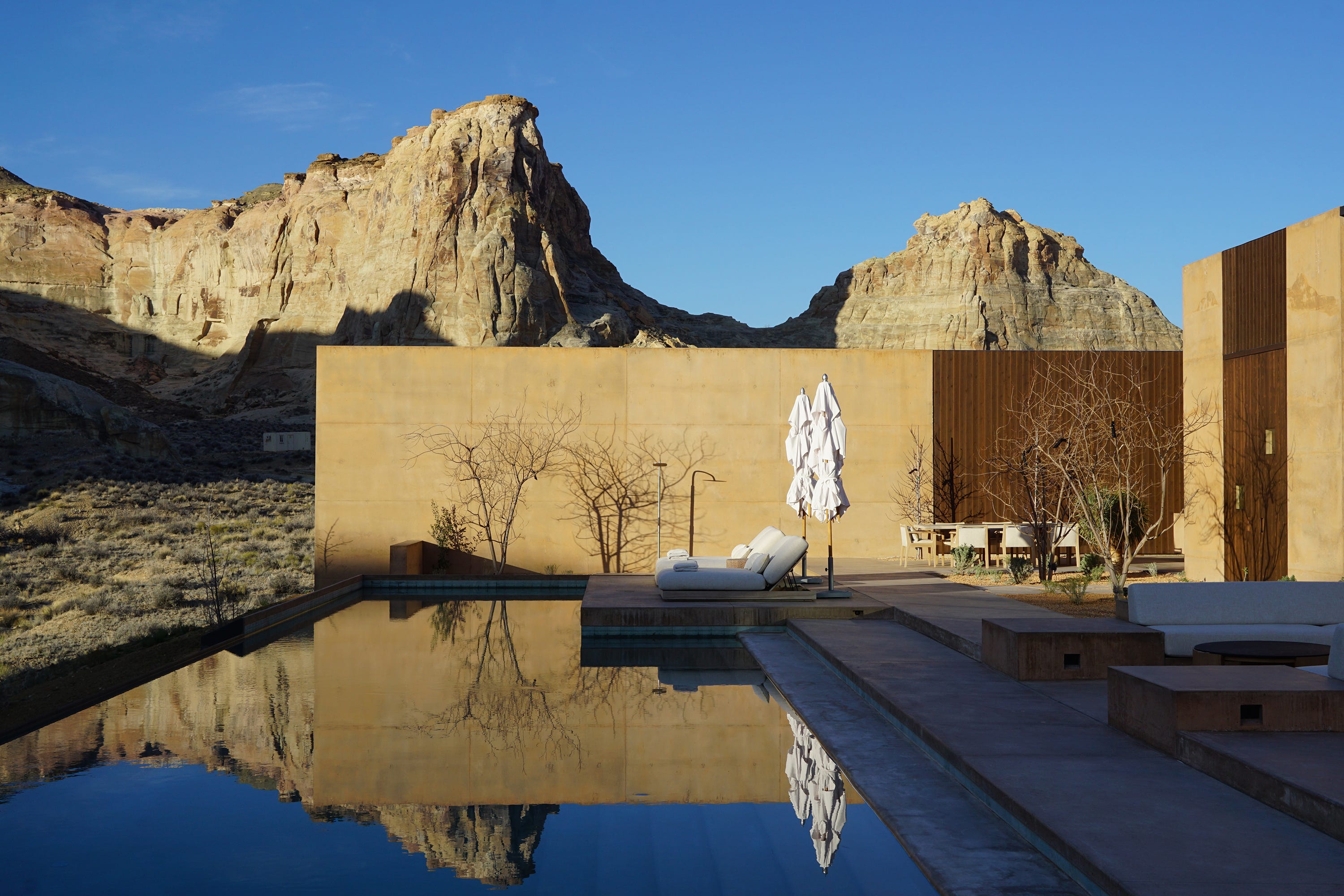
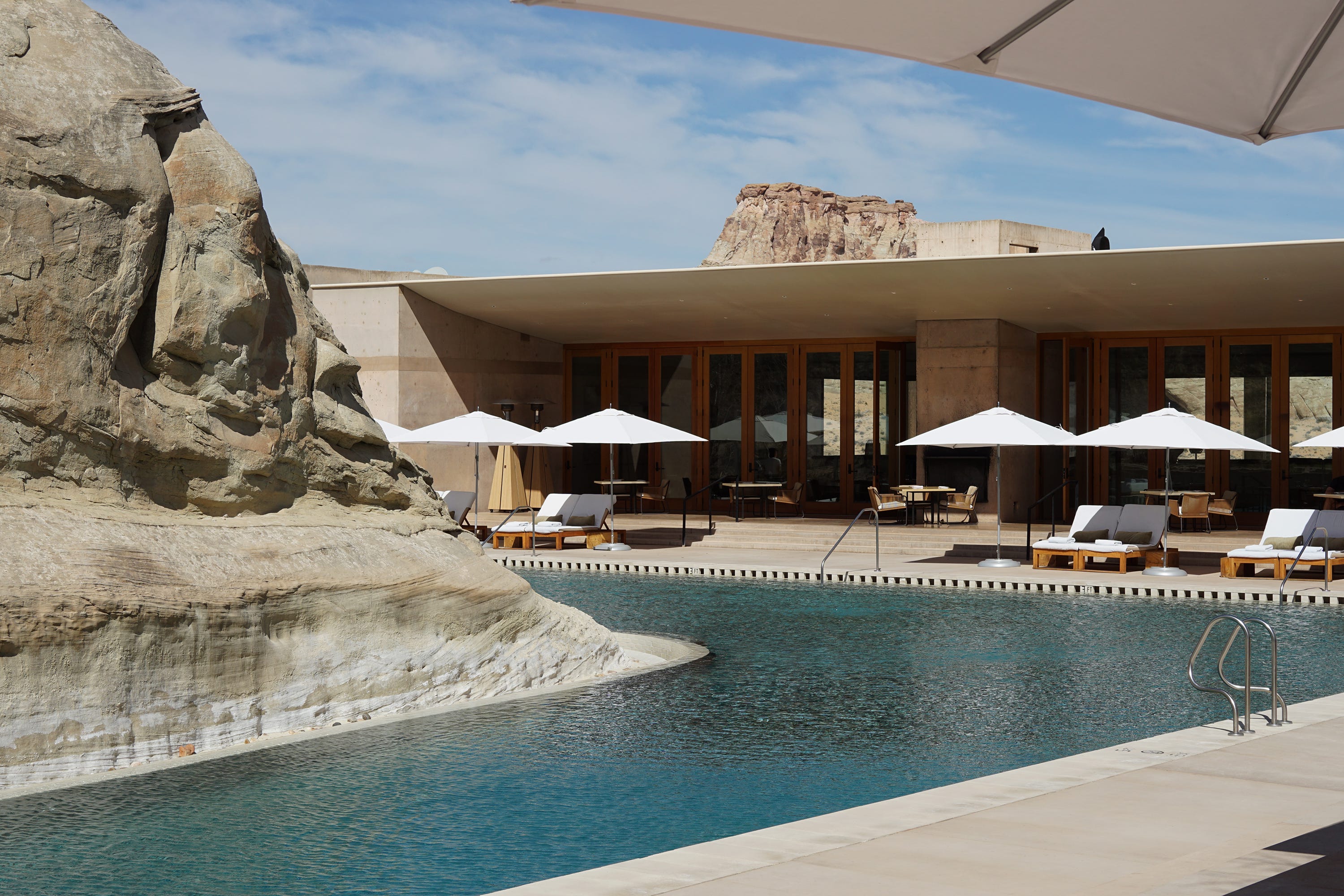
The shadows cast by the intense sunlight create dramatic, highly intentional patterns and geometries across the pigmented concrete. The main swimming pool wraps around a giant rock outcrop and looks like an AI rendering, while the monastic spa transports visitors to a higher plane. Everything, from the sumptuous chocolate-colored bathrobes to the smallest design details, just oozes money.
Yes, I expected the architectural quality, the remoteness, and the tranquility. But what was unexpected—in the best possible way—was the hotel’s connection to the land, its Native peoples, and their culture. The property’s 900 acres across the Colorado Plateau border the Navajo Nation, and the history and presence of this Indigenous community are highlighted and celebrated throughout the resort, rather than ignored—or worse, bastardized or devalued.
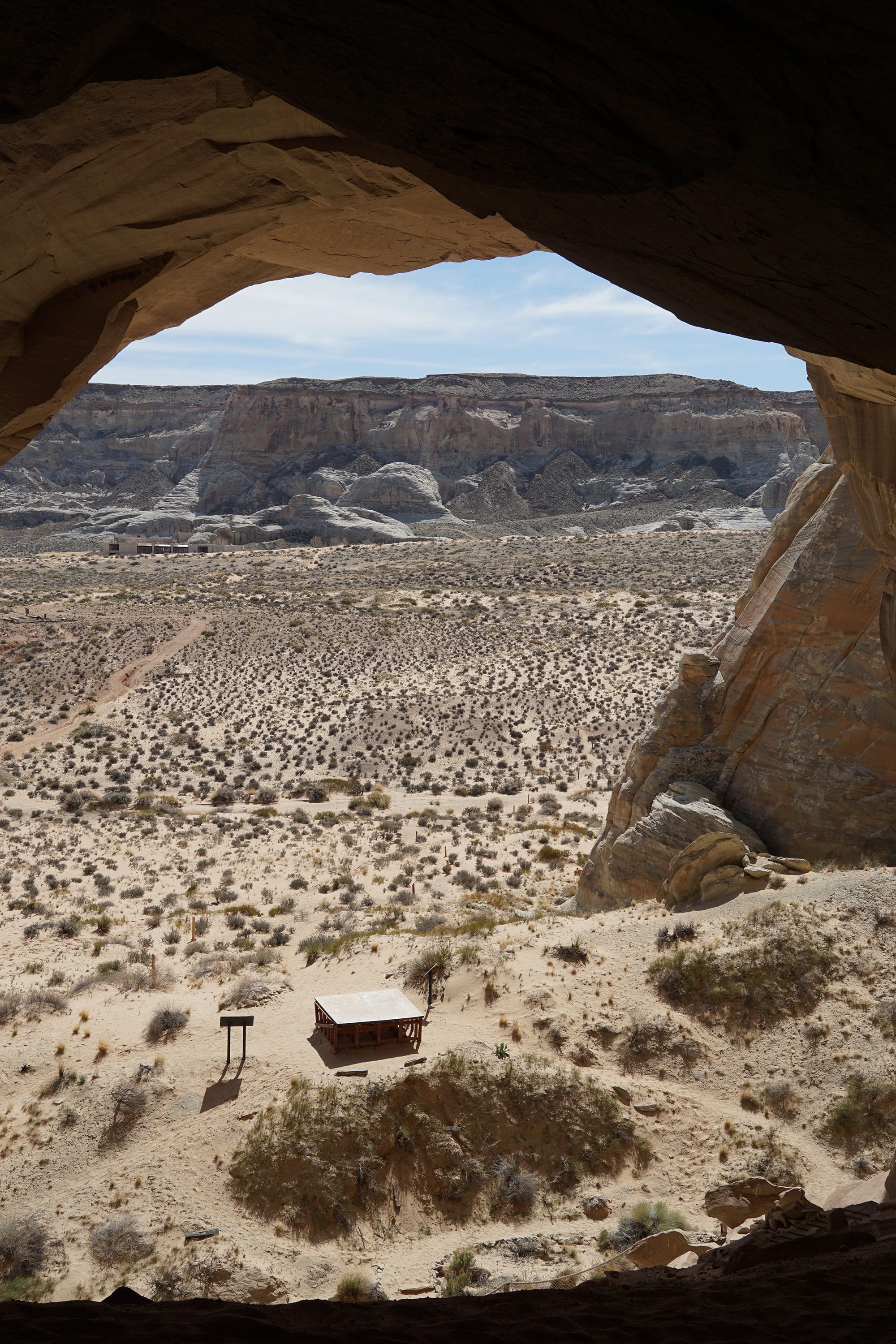
A short 20-minute hike from the hotel lies a huge cave where several prehistoric artifacts have been discovered, from arrowheads that give the feature its name to preserved corn husks. Ancient drawings carved into the stone (sadly accompanied by some contemporary graffiti) demonstrate just how long this landscape has been inhabited, and the scale of the cave—which can only be accessed on a guided tour—is deeply humbling. Broken Arrow Cave is also where artist-in-residence Ulrike Arnold creates her earth artworks using soil collected on-site, sweeping the colorful pigments across canvases to create large-scale paintings that adorn the hotel’s walls.
Then there are the slot canyons, which have become Instagram-famous for their water-sculpted pink walls and shafts of sunlight that beam into their narrow passages. Antelope Canyon is the most visited—and the line outside when we arrived was terrifying. But thankfully we were treated to an exclusive tour of the equally spectacular Coyote, Rattlesnake, and Owl canyons by Raymond, a Native American guide who infused local myth and lore into his geology lessons. The canyons are considered deeply spiritual spaces, and the continuous erosion is seen as a lesson in impermanence.
These canyons informed much of the inspiration for the new Amangiri villa in which we were fortunate enough to stay for three nights. Architect Marwan Al-Sayed and interior designer Mies Anderson of Los Angeles-based Masastudio, which collaborated on the original Amangiri, referenced the canyons’ light shafts when creating hidden voids and skylights throughout the residence. Meanwhile, a central oculus above the huge dining table appears to have been eroded by the elements—much like the hoodoo rock formations in the surrounding landscape—and was inspired by a Navajo prayer titled Walking in Beauty. More design details can be found in my Dezeen article.


One evening, as the sun dipped below the rocks, we were treated to a private music and dance performance by a local group of brothers from the Red Heritage Indigenous Center in Page. The trio were clearly delighted to be there and eager to share their cultural heritage with us. They showcased several styles of powwow and hoop dancing, while wearing traditional garments that they had impressively made themselves. Their leader, Tomas Hunt, stayed for dinner, giving us the opportunity to talk more about life for Native Americans in this part of the country.
Later that night, their mother arrived for fireside story time, and boy, did she have some tales to tell. She spoke about everything from local lore and prayer—including the meaning behind Walking in Beauty—to the plight of her people and the horrific treatment they have faced throughout history. She also explained that Diné—not Navajo—is her people’s preferred name. I could have listened to her speak all night.
Capping off the trip was one of the most incredible experiences I’ve ever had—and likely ever will have. An early morning helicopter ride with Papillon took us over Horseshoe Bend and Lake Powell before ascending to the summit of Tower Butte, a 5,287-foot sandstone formation with tear-inducing 360-degree views across the landscape. Waiting for us at the top was breakfast.
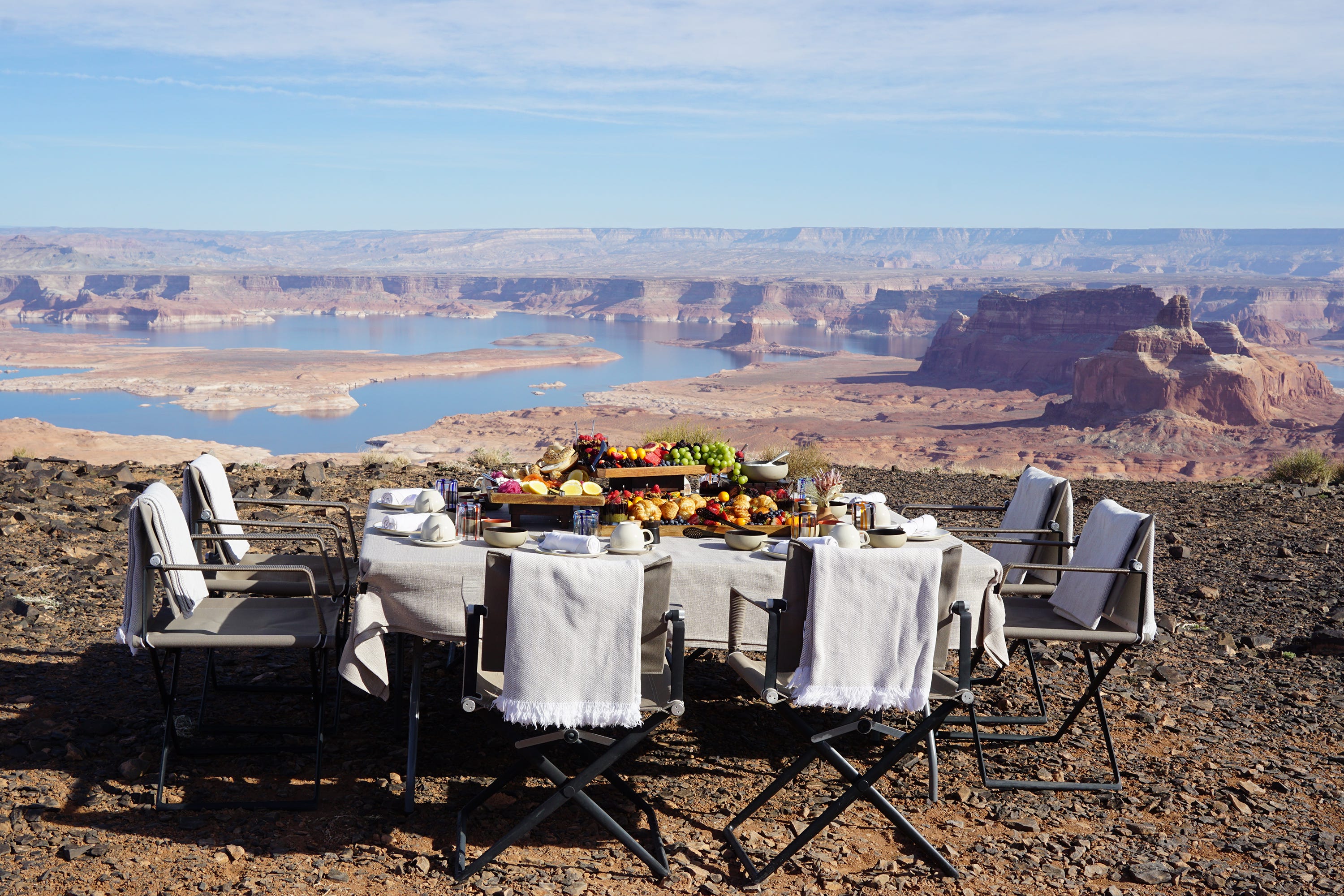
How the hotel team managed to get a cornucopia-style spread of fruit and pastries, coffee and juice—not to mention themselves—all the way up there in time, I will never know. I absolutely welled up a couple of times with pure joy and awe as I nibbled my croissant and gazed out across the desert. The flight back was equally exhilarating as we soared above the canyons while listening to power rock through our headsets.
If this was the Aman that Winnie Landell was talking about in Hacks, she was completely wrong and has terrible taste. Between the exclusive access to extraordinary natural sites and the beautifully personal conversations with Indigenous locals, this was an exceptional and genuinely life-changing trip that I’ll remember forever. For this, I’d happily pay upwards of $5,000 per night, if I could afford to do so. I’m going to need a LOT more Substack subscribers for that! Hehe.
After only one visit, I can’t quite call myself an Amanjunkie yet—I’ll patiently wait for more invitations. (Amankora in Bhutan, Amanera in the Dominican Republic, and the forthcoming Amangati yacht are currently top of my list for anyone from the PR team reading this *wink*.) But I am certainly hooked.
And yes, I have my Amangiri luggage tag proudly displayed on my suitcase, and I take my Amangiri water bottle to the gym as a low-key flex. Sue me!
Far-Flung Corners is currently accepting pitches and partnership opportunities. If you own or represent a hotel or destination that you think would be a great fit for the publication, or would like to explore options for bespoke content, please get in touch!
All photography featured in Far-Flung Corners is my own, unless specified otherwise. Don’t forget to follow @farflung.corners on Instagram for more photos, updates, musings, and more. Love, D x
Thank you for sharing - it does feel like there’s a mythical draw to amangiri! Amanzoe is the one that’s highest on my list personally.
Do you mind sharing a bit more about how you scored such an incredible invite? Was it a press trip? Did you pitch yourself first? Trying to understand how all this works so I appreciate any insight 🙂
It’s good to hear that it is worth it, this hotel has been on my list for quite a while but with always debating if it’s worth it especially because we have been to other Aman’s that are less money but of course willing to pay for experience- depending on what it’s worth of course!